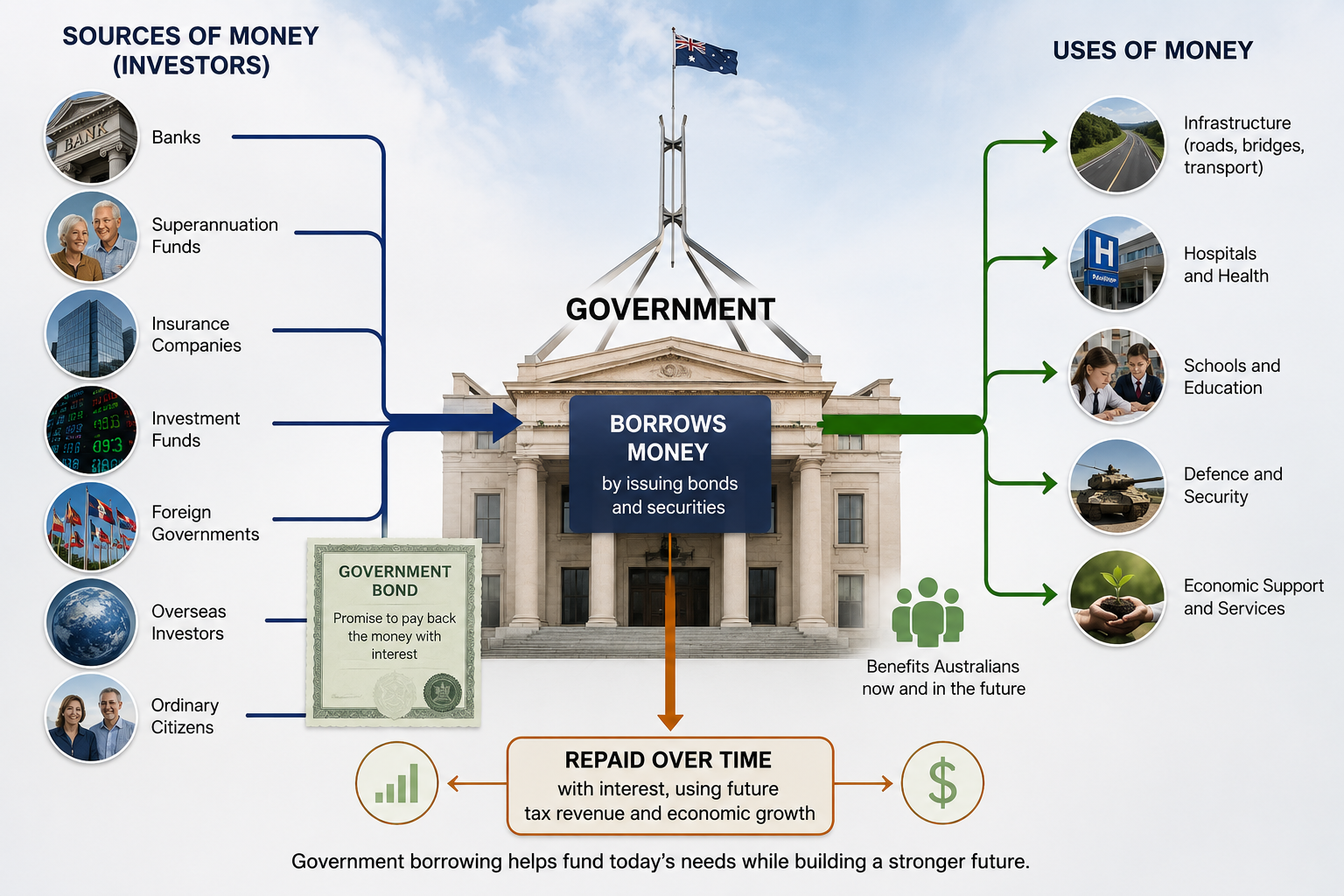
Does the Federal & State Governments borrow money
Yes, they do — and on a massive scale. Here's how it works:
How governments borrow
Governments don't go to a bank and apply for a loan the way you or I would. Instead they issue bonds — also called government securities. A bond is essentially an IOU. The government promises to pay back a set amount on a future date and pay interest along the way.
In Australia, these are called:
- Treasury Bonds — federal government, long term 2 to 30 years
- Treasury Notes — short term, less than a year
- State Government Bonds — each state issues their own, sometimes called semis or semi-government bonds
Who buys them?
- Superannuation funds — your super is likely holding some
- Foreign governments and central banks
- Insurance companies
- Institutional investors
- Banks
- Individual investors can also buy them directly through the ASX
The Federal Government
The Australian federal government currently carries around $900 billion in gross debt and rising. This is managed by the Australian Office of Financial Management (AOFM). Every time the government runs a budget deficit — spending more than it collects in tax — it issues more bonds to cover the difference.
State Governments
Each state borrows separately through their own treasury corporations:
- Queensland — Queensland Treasury Corporation (QTC)
- NSW — NSW Treasury Corporation (TCorp)
- Victoria — Treasury Corporation of Victoria (TCV)
Queensland currently carries around $130 billion in state debt.
What do they borrow for?
- Infrastructure — roads, hospitals, schools, rail
- Covering budget deficits when spending exceeds revenue
- Refinancing old debt that matures
- Emergency spending — COVID was a massive example, Australian government debt roughly doubled during 2020-2021
The interesting irony
Here's where it gets relevant to our earlier conversation. When the RBA raises interest rates to slow down ordinary Australians taking out mortgages and spending less — the government's own borrowing costs go up too. Every rate rise makes it more expensive for the government to refinance its existing debt and issue new bonds.
So the RBA raising rates to cool inflation actually increases the government's interest bill, which can worsen the deficit, which requires more borrowing — it's a somewhat circular problem.
The difference between government and personal debt
There are a few critical differences, though:
Governments can print money — technically in Australia, the RBA can create money, which gives the federal government options no household has. Though doing this excessively causes inflation as we saw post-COVID globally.
Governments don't die — a 30-year bond is manageable because the government will still exist in 30 years. They can also just keep rolling over debt indefinitely, issuing new bonds to pay off old ones.
Governments have taxation power — if they need more revenue, they can raise taxes. You can't do that with your household budget.
Is government debt bad?
It's genuinely debated by economists. The mainstream view is that some level of debt is fine — borrowing to build a hospital or a railway that generates economic activity for decades makes sense, just like a mortgage on a house. The concern is when debt grows faster than the economy and interest payments start consuming a large share of tax revenue, leaving less for services.
Australia's debt to GDP ratio is actually relatively modest compared to countries like Japan, the USA or the UK — but it has grown significantly since 2008 and especially since COVID and shows no sign of shrinking any time soon.
0 Comments
Log in to leave a comment.