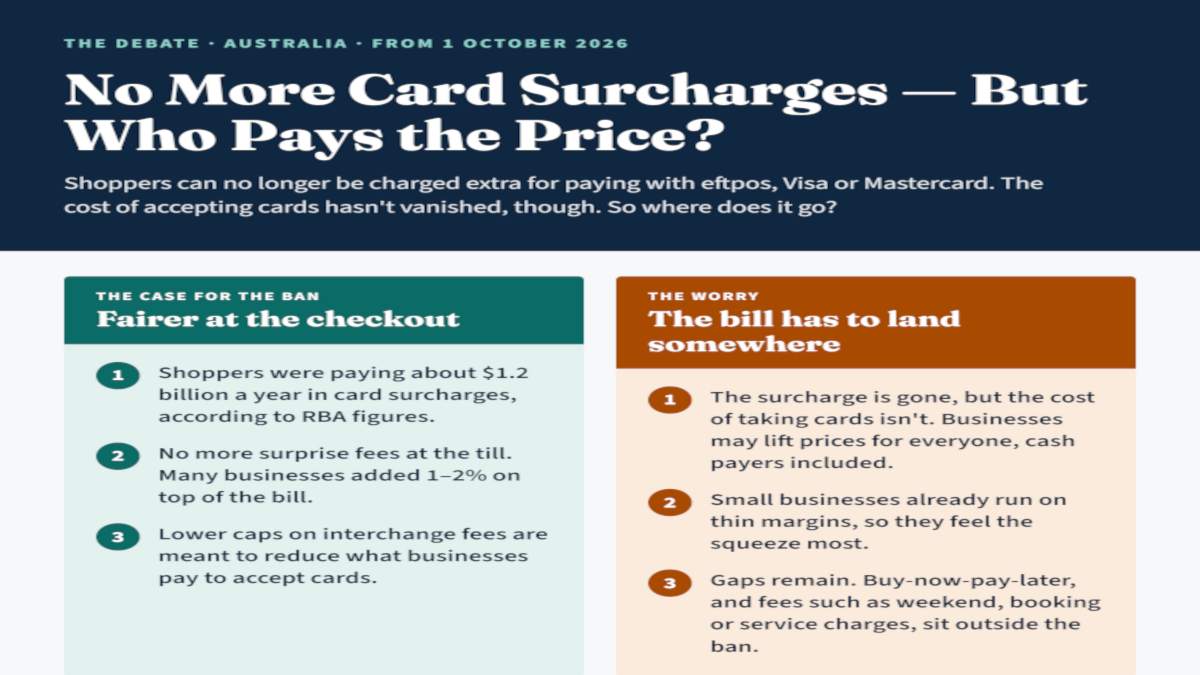
No More Card Surcharges — But Who Pays the Price?
As Time Goes By — a few thoughts on everyday life, customers and small businesses.
Have you noticed the discussion taking place in Australia about credit and debit card surcharges?
From 1 October 2026, businesses can no longer add a separate surcharge for payments made using Visa, Mastercard, eftpos and several other card networks. For customers, this sounds like good news. We will no longer see that extra percentage added to the bill simply because we choose to pay by card.
But I find myself asking a question: if the surcharge disappears, does the cost disappear with it?
Unfortunately, no. Businesses still have to pay for the services that process card payments. The difference is that they can no longer pass those costs on through a separate card surcharge under the new rules. They may have to absorb the cost, adjust their prices, or consider other ways of managing their expenses.
The Reserve Bank of Australia says it is also introducing measures intended to reduce payment costs for businesses and make fees more transparent. That is welcome, particularly for smaller businesses that can have less bargaining power when negotiating with payment providers.
However, I wonder how this change will affect the local café, the independent shopkeeper, the family-run restaurant or the small tradesperson.
Large companies may have the resources to negotiate better rates and absorb additional expenses. A small business operating on tight margins may not have that luxury. Even seemingly modest transaction fees can add up when a business processes hundreds or thousands of payments.
Of course, customers also have a legitimate point. Nobody enjoys reaching the checkout only to discover an additional charge. Clear, upfront pricing makes it easier to understand what we are paying, and removing confusing or poorly disclosed surcharges may make shopping simpler.
But there is another side to the argument. If a small business increases its prices to cover its payment costs, customers may still end up paying indirectly. The difference is that the cost is included in the price rather than shown as a separate charge.
And that raises another question: will the new arrangements genuinely reduce costs for everyone, or will some of the savings be offset by higher prices?
I believe the important thing is fairness and transparency. Customers deserve to know what they are paying, while small businesses deserve a fair chance to operate without being burdened by costs they cannot reasonably manage.
We should also remember that small businesses are part of the fabric of our local communities. They provide employment, support local activities and often give us the personal service that larger chains cannot always offer. When we lose those businesses, we lose more than a shop or a café.
I would like to see the promised reductions in payment-processing costs reach the businesses that need them most, rather than simply becoming another promise that looks good on paper.
What do you think?
Is removing card surcharges a welcome change, or are we simply moving the cost from one part of the bill to another?
And if you run a small business, how do you expect these changes to affect you? Will you absorb the costs, adjust your prices, or look at other payment options?
I'd be interested to hear from both customers and small-business owners. It would be good to bring together a range of views and experiences so we can see how this change is affecting people in practice.
Sometimes, the real story isn't just the decision itself, but how it affects ordinary people in their everyday lives.
Have Your Say
I'd love to hear from you.
Are you a small-business owner affected by the changes to card surcharges, or a customer with views on how these changes might affect prices?
Please share your thoughts and experiences by emailing astimegoesbypeter@gmail.com.
With your permission, I may include some responses in a follow-up article, so we can share different perspectives and encourage a wider conversation.
I look forward to hearing from you!
— Peter
As Time Goes By
0 Comments
Log in to leave a comment.