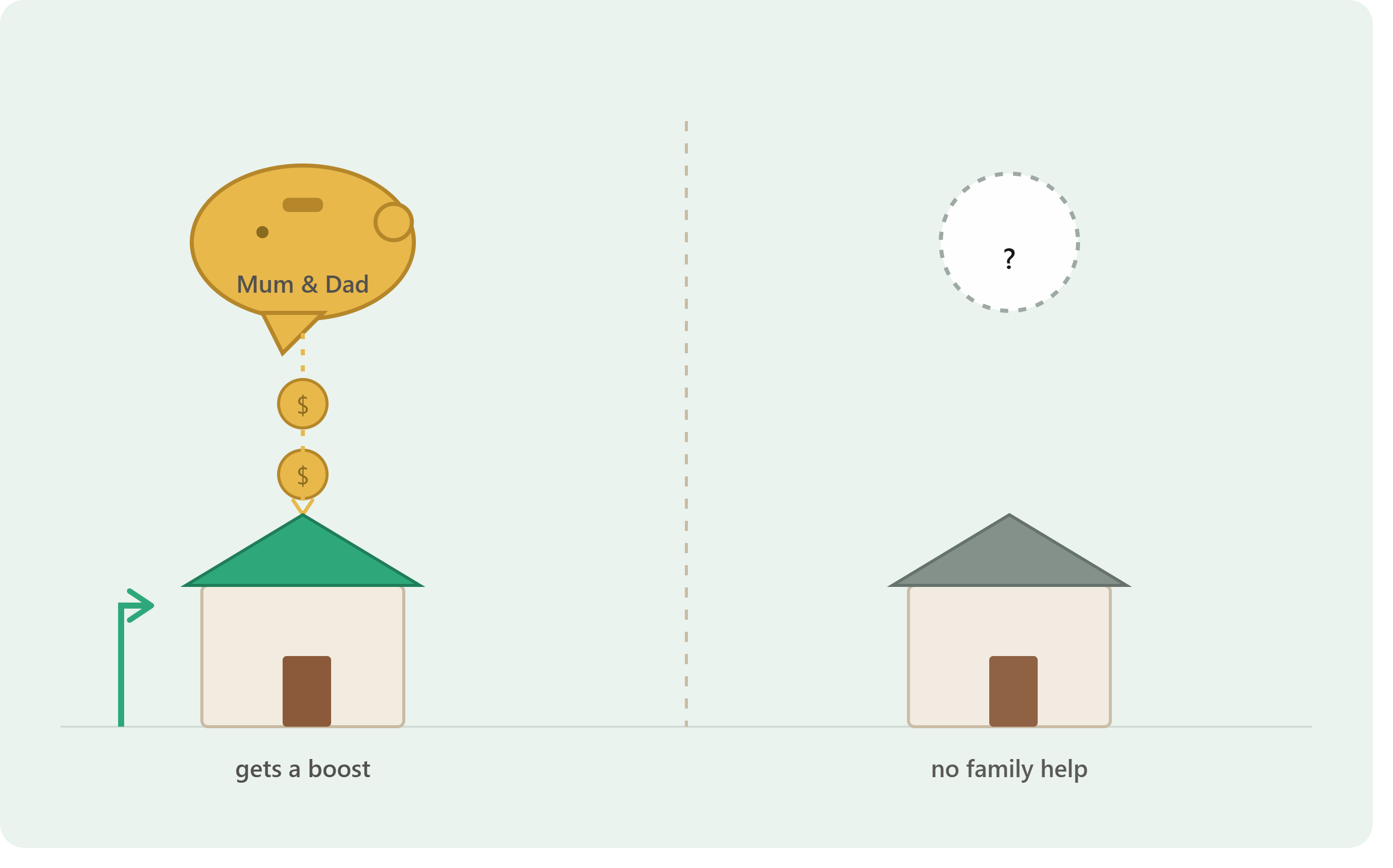
The Bank of Mum and Dad — What About Those Without One?
Has getting ahead in Australia become dependent on the family you were born into?
I read an interesting SBS article recently about what it calls Australia's “Booster Economy” — more than $140 billion worth of everyday financial and practical support flowing from older Australians to younger family members each year.
It made me think about my own children and, before that, about how I started my own adult life.
How it was for me
Perhaps I should go back to the late 1950s.
I got married in 1959. I didn't receive financial help from my parents when I was starting out — not because I expected them to provide it, but simply because I never thought that way.
By 1962, I had four children.
Yet by 1965, I had managed to buy and sell three homes.
I wasn't born into wealth. I didn't have parents putting down a deposit for me. There wasn't a family property portfolio sitting behind me waiting to be passed on.
I worked, earned what I could, borrowed what I needed and got on with life.
Times were different.
I'm certainly not suggesting that young people today aren't working hard. They are.
But when I look at the housing market now, I sometimes wonder how much the starting line has moved.
Then my own children started out
When my children began entering adult life in the 1980s, I saw another side of the financial world.
I remember my eldest daughter, Julia, wanting to buy a car. She went to the bank to arrange a loan, and the bank manager, whom I knew quite well, asked me if I would guarantee the loan for her.
I agreed to look at it.
When I read the fine print, however, I discovered that the interest rate on the loan was going to be 28 per cent.
I can still remember my reaction.
I told the bank manager exactly what I thought about it — and I left without signing the guarantee.
I wasn't prepared to put my name to a loan carrying an interest rate like that, even though it was for my own daughter.
Looking back, that little episode says something about how different the financial world could be.
My other children
My other children were rather different.
They worked hard, built careers and, in three cases, went on to graduate from university. They eventually established their own families and bought homes of their own.
Today, they are comfortably settled, and some live in homes that would be worth millions of dollars.
But I have to say, Sheila and I gave them very little financial help.
Perhaps the biggest contribution we made was simply taking them with us when we emigrated to New Zealand and giving them the opportunity to make their own lives there.
They did the rest themselves.
Looking back, I am proud of that.
Not because we didn't help them, but because we didn't have to buy their way into adulthood.
So what has changed?
This is where the SBS article really caught my attention.
The research suggests that older Australians are now providing more than $140 billion a year in support to younger family members. And that support goes far beyond helping with a house deposit.
It includes groceries, restaurant meals, clothes, travel, cars, appliances, cash and help with debt. Among those surveyed who were providing support, 42 per cent had provided cash and 19 per cent had helped pay off debt.
There is another part of the research that I found particularly interesting.
The SBS article says more than 12 million Australians were found to support younger adult family members in some way. Researchers have called this the “Booster Economy” — wealth and support flowing between generations while parents and grandparents are still alive.
So perhaps the family has quietly become part of Australia's financial safety net.
It's not all about handing over money
One of the stories in the SBS article concerns grandparents who provide regular childcare.
The grandparents aren't necessarily handing their children thousands of dollars.
They're picking children up from school.
They're taking them to sport.
They're helping with homework.
They're cooking meals.
One grandmother even reduced her working hours to help care for her grandchildren while their parents worked full-time. The family estimated that childcare savings could amount to hundreds of dollars a week.
That made me think.
Helping your children isn't always about writing a cheque.
Sometimes it's buying the groceries.
Sometimes it's paying for a meal.
Sometimes it's looking after the grandchildren.
Sometimes it's helping with a bill.
And sometimes it is helping with the deposit on a house.
The Bank of Mum and Dad is getting bigger
And that brings us to housing.
According to Finder research reported by SBS, 30 per cent of surveyed homeowners said they had received family assistance to buy their property. Contributions towards a deposit were the most common form of support, while 8 per cent said their family had bought their home outright.
What really caught my attention was the change over time.
SBS reports that around four years ago the figure was about 10 per cent. It then rose to around 20 per cent before reaching three in ten in the latest research.
That's a remarkable change.
And apparently some older Australians are increasingly releasing wealth earlier rather than waiting for a traditional inheritance after they die.
I can understand why.
If your son or daughter is struggling to save a deposit while house prices keep rising, you may look at the wealth you have built over a lifetime and think:
Why wait until I'm gone?
But what about those without one?
This is where the story becomes more complicated.
There is absolutely nothing wrong with parents helping their children.
Most parents who can help probably want to do exactly that.
I certainly don't begrudge anyone who has parents or grandparents in a position to give them a helping hand.
But what happens to the young Australian whose parents can't?
The SBS article makes that distinction very clearly. Access to this “Booster Economy” is far from universal. Some younger Australians have families who can provide significant support, while others have no such financial safety net — and some are actually supporting their older relatives instead.
That leaves me with a question.
Imagine two young couples.
They have similar jobs.
Similar incomes.
Similar ambitions.
Both work hard.
But one couple has parents who can provide a $100,000 deposit.
The other couple's parents rent themselves, or live on a pension, or simply don't have the money.
Are those two young couples really starting from the same place?
From inheritance to support while you're still alive
SBS also reports that one in ten Australians surveyed say they will need an inheritance to achieve a major financial goal such as buying property.
That is a remarkable thought.
We traditionally think of inheritance as something that happens after someone's parents die.
But perhaps we are increasingly moving towards a system where family wealth is being transferred while the older generation is still alive because younger people need the help now.
One day, that may simply become normal.
But I can't help wondering what it means for people who don't have family wealth to draw on.
Is financial independence changing?
There is another part of the SBS article that I found rather interesting.
The idea of what it means to be financially independent may itself be changing.
For years, an adult child continuing to live at home was sometimes seen as failing to “leave the nest”.
But multi generational living has always been perfectly normal in many cultures.
The SBS article suggests financial pressures could encourage more Australians to embrace that model — several generations living together because financially it makes sense, rather than because anyone has failed to become independent.
Perhaps that wouldn't be such a bad thing.
Families could share costs.
Grandparents could help with childcare.
Parents could support older relatives.
Children could remain at home longer.
There could even be social benefits.
As one person quoted in the SBS article put it, perhaps the philosophy that “it takes a village to raise a family” could become more important again.
But I keep coming back to housing
For me, this isn't really an article about parents helping their children.
It is about why so many families increasingly feel they have to.
When I was starting out, I didn't have a Bank of Mum and Dad.
Neither did my children to any great extent.
We worked, built careers, bought homes and got on with life.
Today, however, housing prices have moved so far ahead of incomes that family assistance is becoming much more important for some people trying to get into the market.
That concerns me.
Because once family wealth becomes part of the equation, the question isn't simply:
“How hard do you work?”
It can also become:
“What did your parents happen to own?”
And that's where the real inequality may lie
I'm not suggesting that we should stop families helping each other.
Quite the opposite.
If parents can help their children, good luck to them.
If grandparents can provide free childcare, that's wonderful.
If families can live together and support one another, perhaps we should celebrate it.
But I don't think a young Australian should need wealthy parents to have a reasonable chance of owning a home.
That is where I think the broader housing debate needs to go.
We talk about supply and demand.
We talk about interest rates.
We talk about developers, banks and governments.
We talk about negative gearing and capital gains tax.
And now we can add another factor:
family wealth.
Perhaps the question we should really be asking is whether we are gradually creating a society where your starting point depends too heavily on the family you were born into.
I began my adult life with four children, a young wife and no Bank of Mum and Dad behind me.
By 1965, I had bought and sold three homes.
My children went on to build their own careers and families.
Times were different.
The world has changed enormously since then.
I don't expect it to stand still.
But I do wonder whether we have reached a point where simply working hard and doing your best is no longer enough for everyone to get a reasonable start.
And perhaps that is the question I would like to leave you with:
Should having a secure home depend so heavily on what your parents can afford to give you?
Because if the answer is yes, then perhaps the problem isn't with young people.
Perhaps the system itself needs another look.
0 Comments
Log in to leave a comment.